In Part 1 I wrote about why celebrity-endorsed gold dealers keep collapsing. This piece is about the quieter thing underneath it: what you actually pay when you buy gold or silver, and why the number is so often hidden from you.
Let me clear up the biggest misunderstanding first. The problem in this industry has never been that dealers charge a premium. Of course they charge a premium. Metal has to be minted, shipped, stored, and insured, and a business has to make a living. A fair premium is normal and fine.
The problem is a premium you can’t see. A price that isn’t shown to you, isn’t explained, and changes depending on who happens to be selling to you that day. That is the real story of nearly every gold scam, and once you can spot it, you can never be sold that way again.
An honest price has three properties
You don’t need to be an expert to judge a precious-metals quote. You need to check three things.
You can see the full, all-in number before you buy. Not “call for pricing.” Not a number that appears only after an hour on the phone. The total, including any fees, in front of you, before you commit.
It’s explained. A transparent seller can tell you in one sentence what makes up the price and what each part is for. A dishonest one changes the subject to how rare or special the coin is.
It’s the same regardless of who’s selling to you. An honest price does not depend on how good a salesperson is at reading you. If two people can call the same company and be quoted very different numbers for the same metal, the price was never really about the metal.
Almost every scam is a disclosure failure
Look closely at the enforcement cases and you’ll notice they aren’t really about high prices. They’re about hidden and misrepresented ones.
- Red Rock Secured told investors they would pay markups of 1% to 5%, and actually charged as much as 130% (SEC).
- Safeguard Metals claimed a maximum markup of 23%, and charged an average of 71% (CFTC).
- Metals.com sold coins at 100% to more than 300% over the value of the metal, to at least 1,600 mostly elderly customers (CFTC).
The pattern isn’t “they charged a lot.” It’s “they said one thing and did another.” The customer could not see the real price, so the customer could not say no. That is what transparency prevents.
Why the price gets hidden in the first place
Follow the incentive and it all makes sense. When a company pays its salespeople a commission tied to how much you pay, opacity becomes the business model. The less clearly you can see the price, the more room there is to inflate it, and the more the person on the phone earns. That’s not a conspiracy. It’s just the math of a commissioned sales floor, and it explains the whole thing.
It’s also why the fees can get staggering. The CFTC has documented a single $300,000 retirement rollover that carried roughly $150,000 in fees and commissions (CFTC). Half of someone’s savings, gone before the metal moved a dollar, precisely because they could not see what they were paying.
The “rare coin” trick is really a hiding trick
Here’s the part that ties it together. When a salesperson steers you away from a plain, common coin and toward a “proof,” “exclusive,” “semi-numismatic,” or “collectible” one, the point usually isn’t the coin. It’s that a special coin has no obvious price to compare against. A one-ounce American Eagle has a well-known value. A “limited exclusive proof” does not, which is exactly what makes it the perfect place to hide a markup you would never agree to if you could see it plainly.
If you’re using a retirement account, there’s a second reason to be wary: the IRS generally does not allow collectible coins inside an IRA. A rep who insists a “rare” coin belongs in your retirement account is showing you a red flag with both hands.
The one test that needs no math
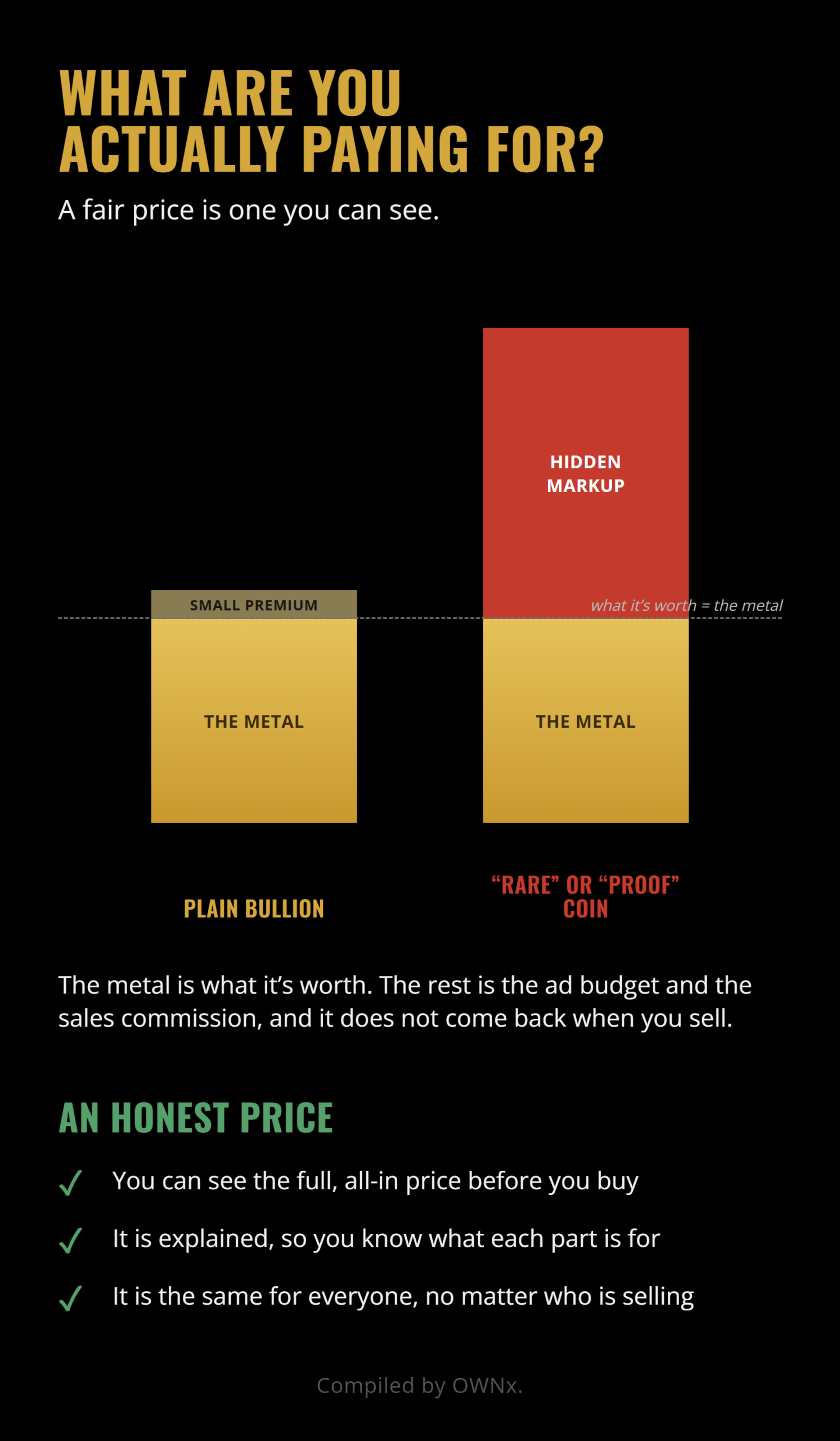
You can look up the market value of gold or silver in a second if you want to. But you don’t even have to. There’s a simpler question that cuts straight through everything above: what is this actually worth the moment I own it?
Not what it’s priced at. What it’s worth. For a plain bullion coin bought at a fair price, the answer is “close to what I paid,” because its worth is the metal, and the metal has a public value any buyer will honor. For an overpriced “proof” or “collectible,” the honest answer is often “a fraction of what I paid,” because the resale market, whoever the next buyer turns out to be, only ever cared about the metal. That difference is the hidden premium, in plain dollars. It was never really yours. It went to the ad budget and the commission the day you bought.
So before you buy metal from anyone, get these in writing:
- The full, all-in price, today.
- What the same item would resell for on the open market today, to any buyer, not only the dealer selling it to you.
- Whether that’s the same price everyone pays, or one that depends on who’s doing the selling.
- How the person selling it to you is paid.
An honest seller answers all four without flinching. The point isn’t to trade in and out of metal. It’s to know, before you buy, whether you’re paying for the metal or for someone’s marketing.
How we think about it at OWNx
I’ll be straight with you, the same way I was in Part 1. OWNx is not always the lowest price on the internet for a single coin, and I won’t pretend otherwise. What we can promise is that you’ll always be able to see the number. Our pricing is published and on the screen before you buy. It’s the same number for everyone, because there’s no commissioned rep whose paycheck goes up when yours does. Members can buy at cost, storage and insurance are disclosed rather than buried, and the metal is allocated in your name and held in an insured depository.
That last part matters for everything above. Because you’re buying real metal at a fair, visible price, and you actually own it, what you hold is worth what the metal is worth. There’s no marketing premium sitting on top of it waiting to evaporate. You can keep it stored and allocated, which is usually the simplest thing, or take delivery, but either way the value is the metal, not a story about the coin.
That’s the whole idea of this piece. A fair price isn’t the lowest number you can find. It’s the number you’re allowed to see, explained honestly, the same for you as for anyone else. Everything else in this industry is just a way of keeping you from looking.
Frequently asked questions
What should a fair gold or silver price include?
A fair quote shows you the full, all-in cost before you buy, explains what each part covers (metal, minting, shipping, storage, insurance, dealer margin), and is the same regardless of which salesperson you reach. If any of those is missing, treat the price as hidden.
How can I tell if I’m being overcharged for gold?
Compare what you pay to what the same item is worth on the resale market, what any buyer would give you for it, not only the dealer who sold it. For plain bullion that gap is small. For an overpriced ‘collectible’ it is large, because the market only values the metal. That gap is the premium you will never get back.
Why do dealers push ‘proof’ or ‘collectible’ coins?
Because a special coin has no obvious market price to compare against, which makes it the easiest place to hide a large markup. Regulators have found these coins sold at 71%, up to 130%, and 100% to 300% over the value of the metal.
Is a higher premium always a scam?
No. Premiums are normal and cover real costs. The warning sign is not the size of the premium, it is whether it is disclosed. A price you can see and that is explained is honest. A price that is hidden, misrepresented, or different for everyone is not.